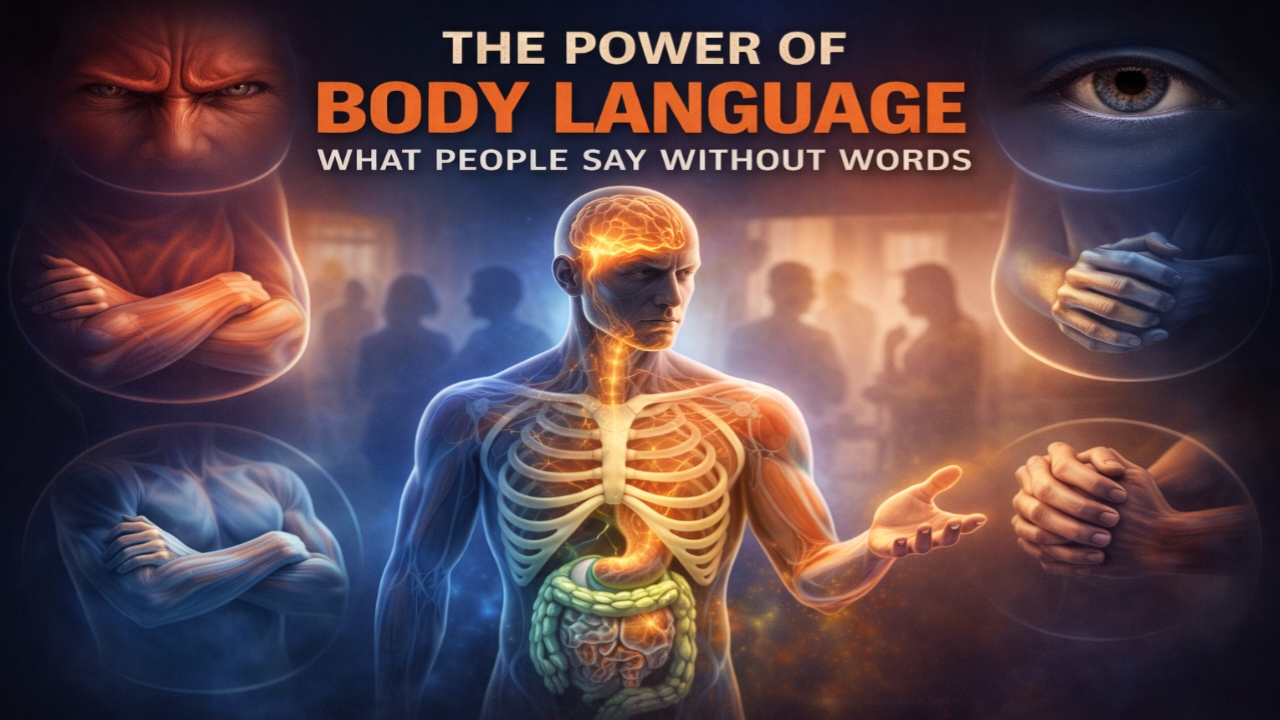
The Power of Body Language: What People Say Without Words:
Have you ever walked into a room and instantly felt the mood—without anyone saying a word?
That’s body language at work.
Long before humans developed complex speech, our bodies were already communicating. Even today, research suggests that more than 60% of human communication is non-verbal. Facial expressions, posture, gestures, and eye contact silently shape how others perceive us—often more than our words ever could.
Let’s decode what people are really saying without speaking.
Why Body Language Is So Powerful
Body language works because it is:
- Fast – processed by the brain in milliseconds
- Instinctive – hard to fake consistently
- Universal – many signals cross cultures
While words can be chosen carefully, body language often reveals true emotions before logic steps in.
1. Facial Expressions: The Emotional Billboard
The human face can express thousands of emotions, but psychologists focus on seven universal expressions:
- Happiness
- Sadness
- Anger
- Fear
- Surprise
- Disgust
- Contempt
Even micro-expressions—fleeting facial movements lasting less than a second—can reveal emotions people try to hide.
Example:
A forced smile may lift the lips, but genuine happiness activates the eyes. If the eyes don’t engage, the emotion likely isn’t real.
2. Eye Contact: Confidence or Discomfort
Eyes are one of the strongest non-verbal communicators.
- Steady eye contact → confidence, interest, honesty
- Avoiding eye contact → discomfort, nervousness, or distraction
- Excessive staring → dominance or aggression
Balanced eye contact builds trust. Too little or too much can send the wrong signal.
3. Posture: How You Carry Yourself Speaks Volumes
Posture reflects both mindset and emotional state.
- Open posture (shoulders back, chest open) → confidence, openness
- Closed posture (crossed arms, hunched shoulders) → defensiveness, insecurity
- Interestingly, posture doesn’t just reflect confidence—it can create it. Standing tall can actually improve mood and self-perception.
4. Hand Gestures: Reinforcing or Undermining Words
Hands add clarity and emotion to communication.
- Open palms → honesty, trust
- Pointing fingers → aggression or authority
- Fidgeting → anxiety or impatience
- People who use natural hand gestures are often perceived as more persuasive and trustworthy.
5. Personal Space: The Invisible Boundary
Psychologists divide personal space into zones:
- Intimate (close family, partners)
- Personal (friends)
- Social (coworkers, strangers)
- Public (presentations)
Invading someone’s space can cause discomfort, while too much distance may signal disinterest.
6. Mirroring: The Silent Bond Builder
When people subconsciously mirror each other’s posture, gestures, or tone, it’s a sign of:
- Rapport
- Comfort
- Emotional connection
Mirroring often happens naturally when people feel aligned or understood.
How to Improve Your Own Body Language
You don’t need to act or exaggerate—small adjustments make a big difference:
- Relax your shoulders
- Maintain natural eye contact
- Keep your posture open
- Use calm, purposeful gestures
- Be present in the moment
Authentic body language always beats forced confidence.
Final Thoughts
Words can lie.
Body language usually doesn’t.
By paying attention to non-verbal cues, you can:
- Understand people better
- Communicate more clearly
- Build trust faster
- Avoid misunderstandings
In a world full of noise, the quiet signals often speak the loudest.

1 thought on “The Power of Body Language: What People Say Without Words”